Contributed research, synthesis, user journeys, login and onboarding, ShortCode creation, sharing, and rich media direction flows.
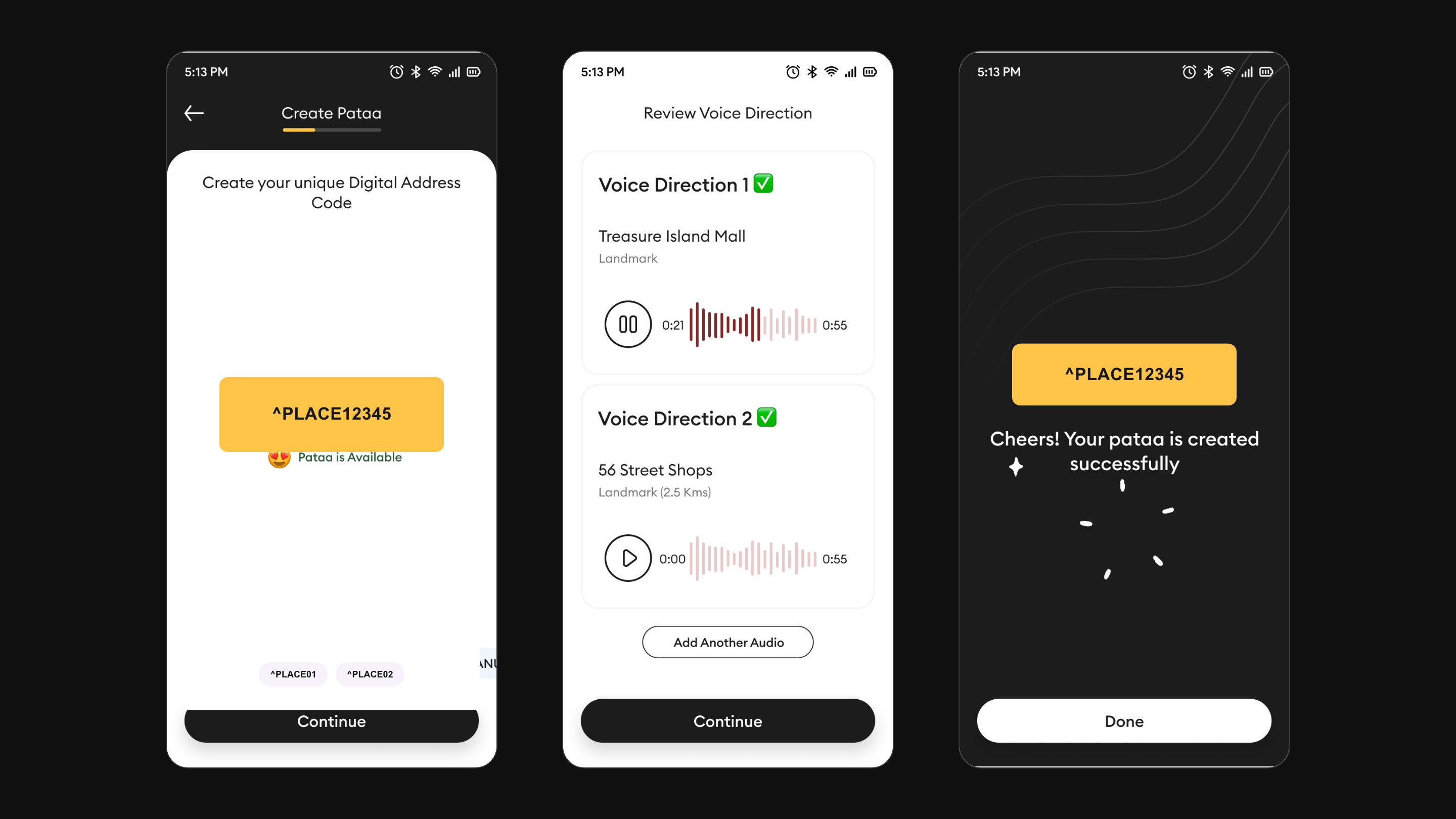
IMAGE UNAVAILABLEPataa design flow for address creation.
IMAGE UNAVAILABLEShortCode selection step.
IMAGE UNAVAILABLEAddress details step in the staged flow.
CASE 06Live consumer product; team redesign documented in 2022
Pataa: An address that gets you to the door
A written address often guides a rider only to the general area. Pataa resolves a memorable ShortCode to one block measuring 3 metres by 3 metres, then carries the final approach through voice, photos, and landmarks. Neel joined the team in 2022 to improve creation, onboarding, sharing, and arrival guidance within the existing product.
Research, synthesis, and product design were shared across the team. The ShortCode and location platform predated the redesign.
Pataa's 7.5M+ downloads describe the app's overall reach, not the impact of Neel's contribution.
The address ended before the person arrived
In the team's comparison, “College Tilla, Agartala” resolved to roughly 76 square kilometres. Reaching the area was not the same as finding the entrance.
The redesign reframed the job from shortening an address to making the last approach precise, recognizable, and shareable.
- A delivery rider who needs the exact door and a recognizable cue quickly.
- A sender who needs one precise object to share without narrating the route repeatedly.
- Mohan, a persona representing limited connectivity and other edge conditions, who pushed the design toward voice, multilingual guidance, large controls, and simple sequencing.
- A short code alone does not solve the last twenty metres.
- The address must work for both the person creating it and the person arriving.
- Live location sharing must be explicit and easy to stop.
The product mediates physical arrival and location sharing, so precision and visible consent matter more than decorative novelty.
01 / Arrival model
Area → exact block → entrance people recognize
The existing product resolves a memorable code to one block measuring 3 metres by 3 metres. The redesign work focused on the journeys and human directions that carry someone from that block to the door.
Research moved the brief beyond a shorter code
Six interviews, affinity synthesis, three personas, and two rounds of testing shaped the redesign.
Delivery agents, logistics staff, and everyday travellers described how vague addresses fail in use.
The recurring patterns reshaped the design brief.Raw findings moved through affinity mapping, card sorting, and trend analysis before the brief changed.
The themes connected route finding, clarity, and low connectivity needs.Rajesh, Anjali, and Mohan spanned professional delivery, mainstream navigation, and limited connectivity use.
The profiles kept different arrival conditions visible throughout the design.An internal review came first; moderated sessions with six users selected to match the personas followed.
Early review shaped the direction before moderated user sessions.01 / Product overview
The redesign in context
The product montage connects ShortCode creation, voice directions, sharing, and live state before the individual mobile steps are examined.
IMAGE UNAVAILABLEPataa design flow for address creation.
Create a Pataa
Three design states follow one address from ShortCode choice through voice direction review to creation confirmation.
Endpoint accuracy, inclusion of users with the greatest constraints, and visible consent set the bar
A priority ladder from P0 through P3, the Mohan persona representing edge conditions, and the active location sharing state turned research into interaction rules.
Should the redesign merely make addresses shorter?
Reframe the brief around an address people can trust at a glance and act on without a phone call.
Research showed that a shorter code still leaves the last twenty metres unresolved.
REJECTED PATH Treat a shorter code similar to a PIN as the complete solution.
Which user should set the interaction bar?
Use Mohan, the persona representing limited connectivity and other edge conditions, to force voice, multilingual cues, large controls, and simple sequencing into the design.
Mohan's needs made support for limited connectivity and simple interaction part of the design brief.
REJECTED PATH Optimize only for people who use smartphone maps fluently.
How should active location sharing appear?
Show a prominent active state card with recipient, duration, countdown, and an immediate stop control.
A design must not be quiet or ambiguous while broadcasting a person's location.
REJECTED PATH Hide sharing state or its stop control inside deeper navigation.
What should enter scope first?
Put resolving address complexity and accurate endpoint navigation in P0, then sequence integration and personalization before multilingual support and community work.
The priority ladder made one shared scope decision visible before the team debated individual screens.
REJECTED PATH Treat every research opportunity as equally urgent.
How should the team move from ideas to testable structure?
Start at low fidelity with Crazy 8s sketches, vote on feasibility, desirability, and viability, then continue at medium fidelity in Figma.
A round dedicated to deliberately bad ideas loosened the first obvious answer; testing in two phases checked the selected direction.
REJECTED PATH Polish the first plausible concept before prioritization or review.
The route resolves in layers, not one overloaded form
The redesign treated a Pataa as an object a person creates, enriches, and shares: one block underneath, human guidance layered on top.
01 / Create the code
Progressive address creation
Choose a ShortCode between 7 and 11 characters long with suggestions, add address details, then place the exact entrance block without confronting every field at once.
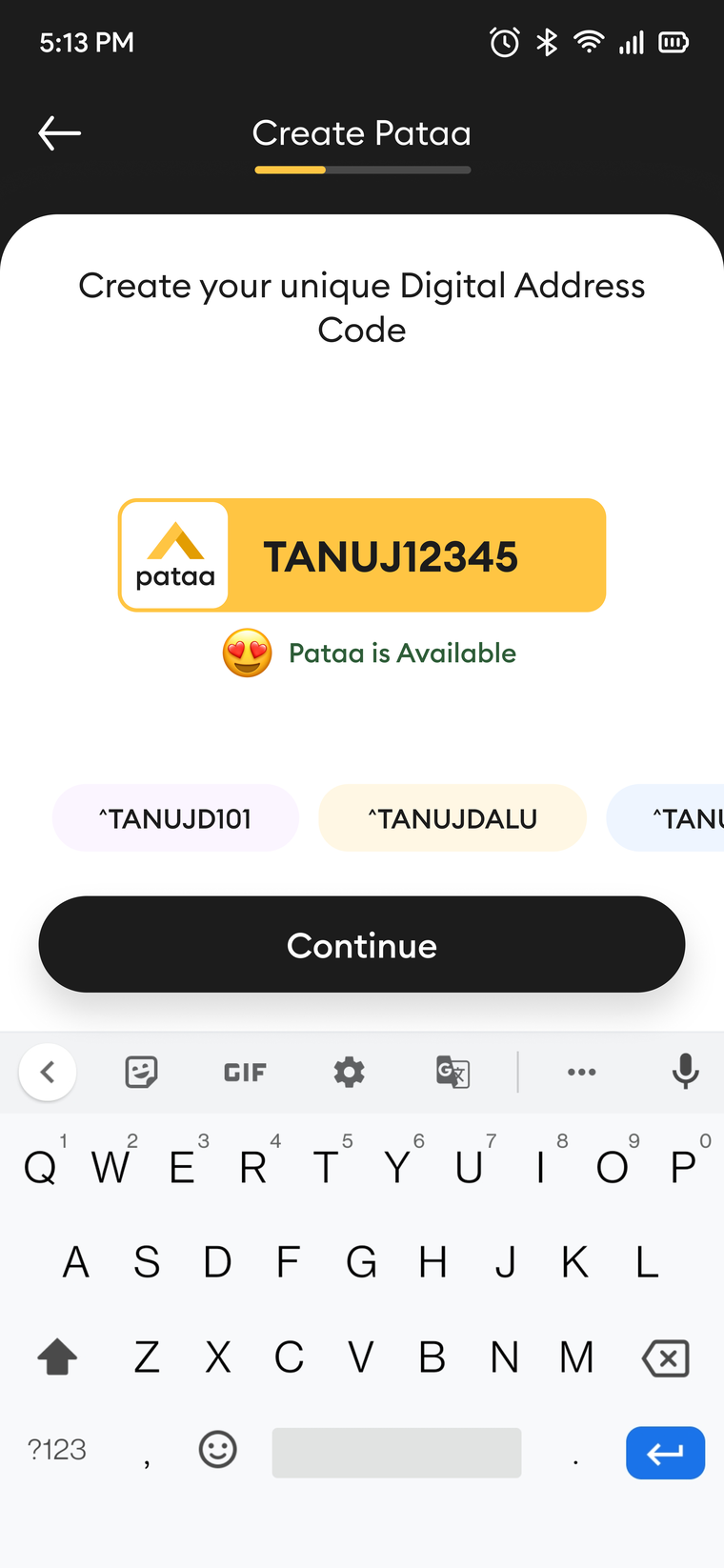
IMAGE UNAVAILABLEShortCode selection step.
Create the code
ShortCode selection step.
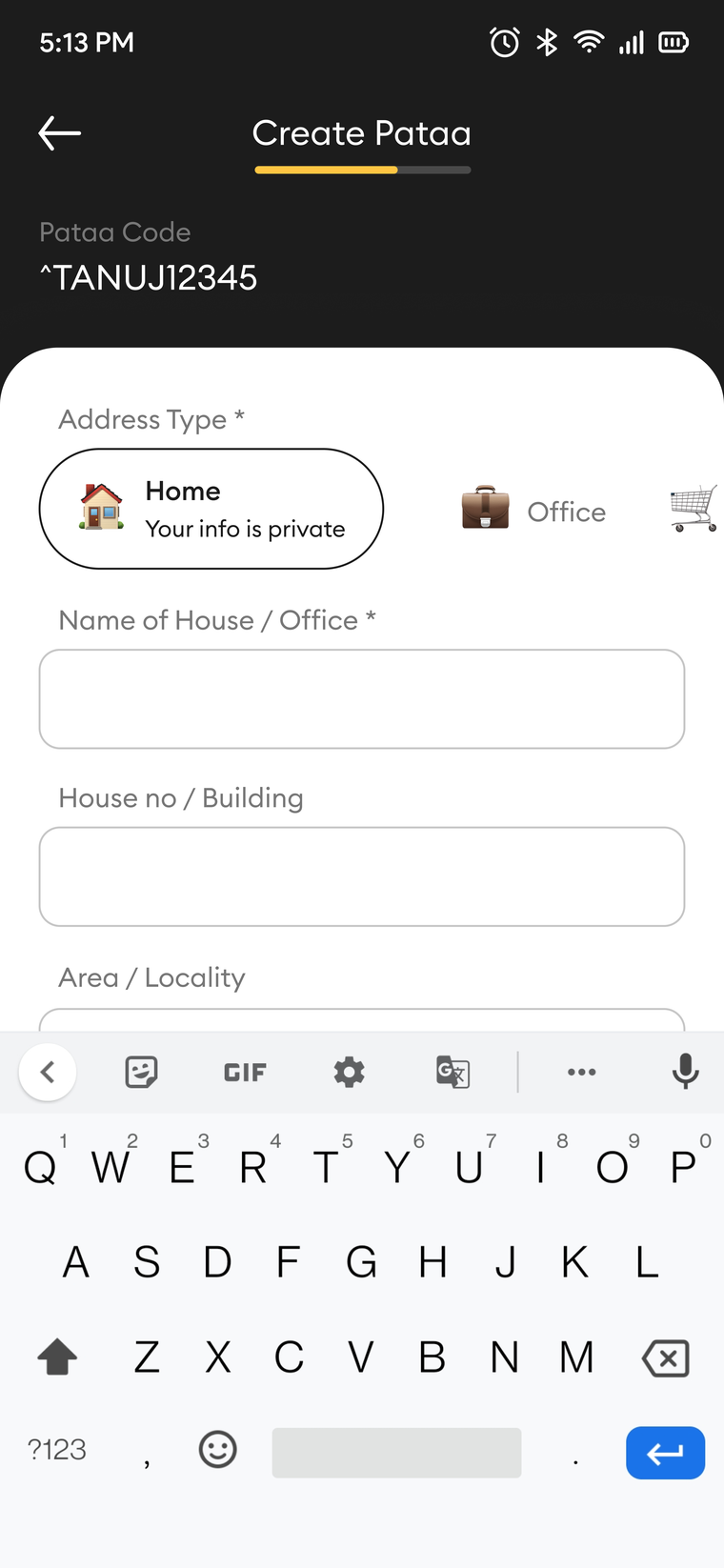
IMAGE UNAVAILABLEAddress details step in the staged flow.
Create the code
Address details step in the staged flow.
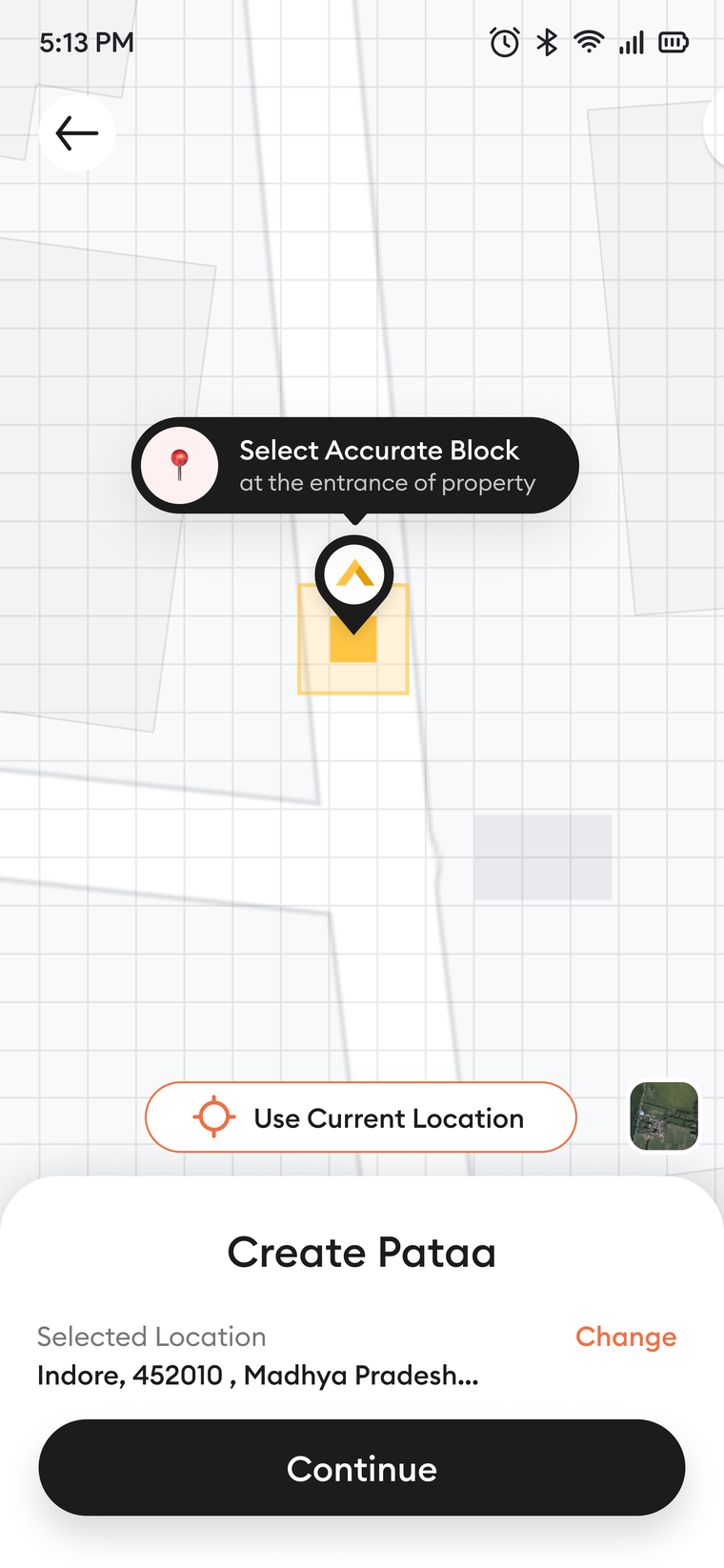
IMAGE UNAVAILABLEExact entrance block step in the staged creation flow.
Create the code
Exact entrance block step in the staged creation flow.
02 / Recognize the entrance
Reusable photo and voice directions
Attach up to three entrance photos and one or more ordered voice directions. Landmark labels, waveform review, English and Hindi modes, and synthesized speech make each cue useful beyond the code itself.
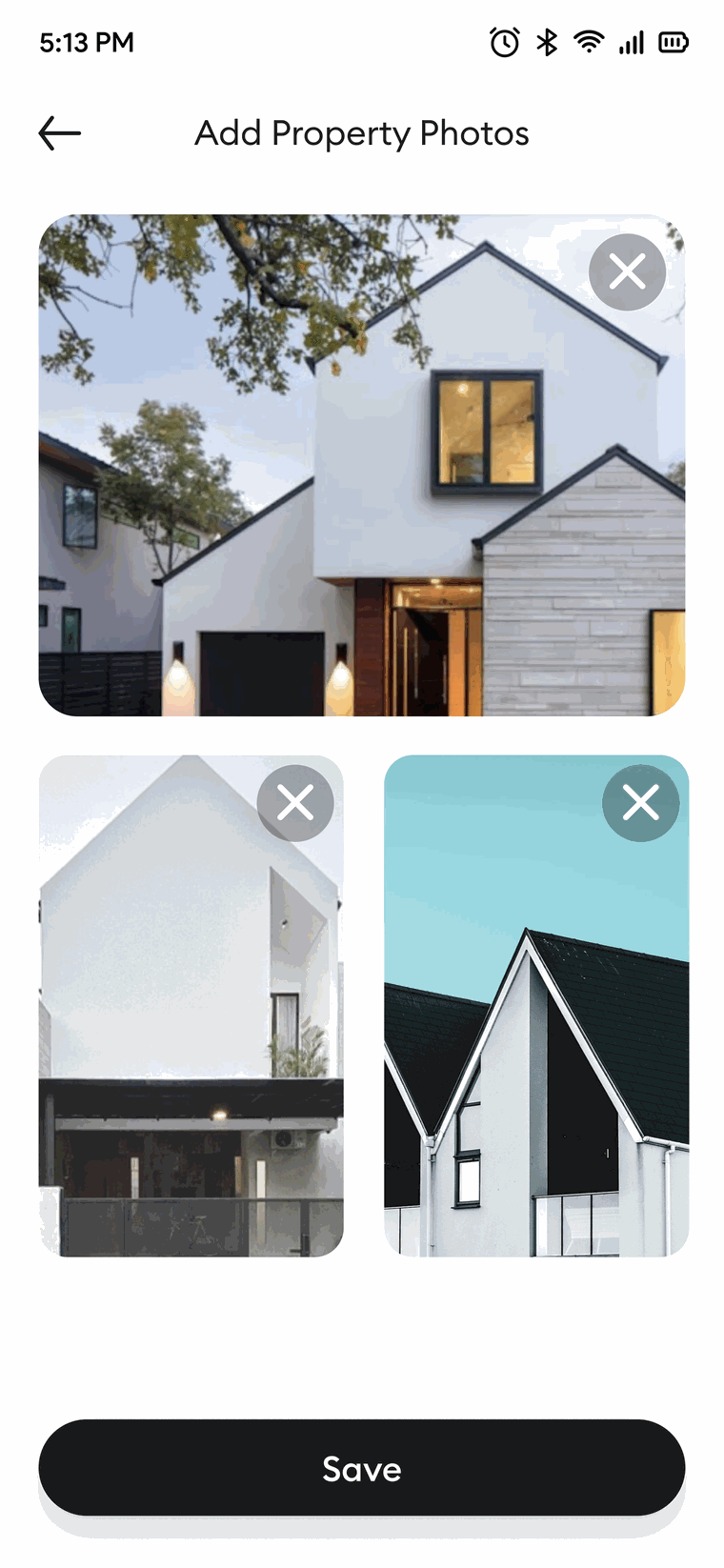
IMAGE UNAVAILABLEPhoto direction step for recognizing the entrance.
Recognize the entrance
Photo direction step for recognizing the entrance.
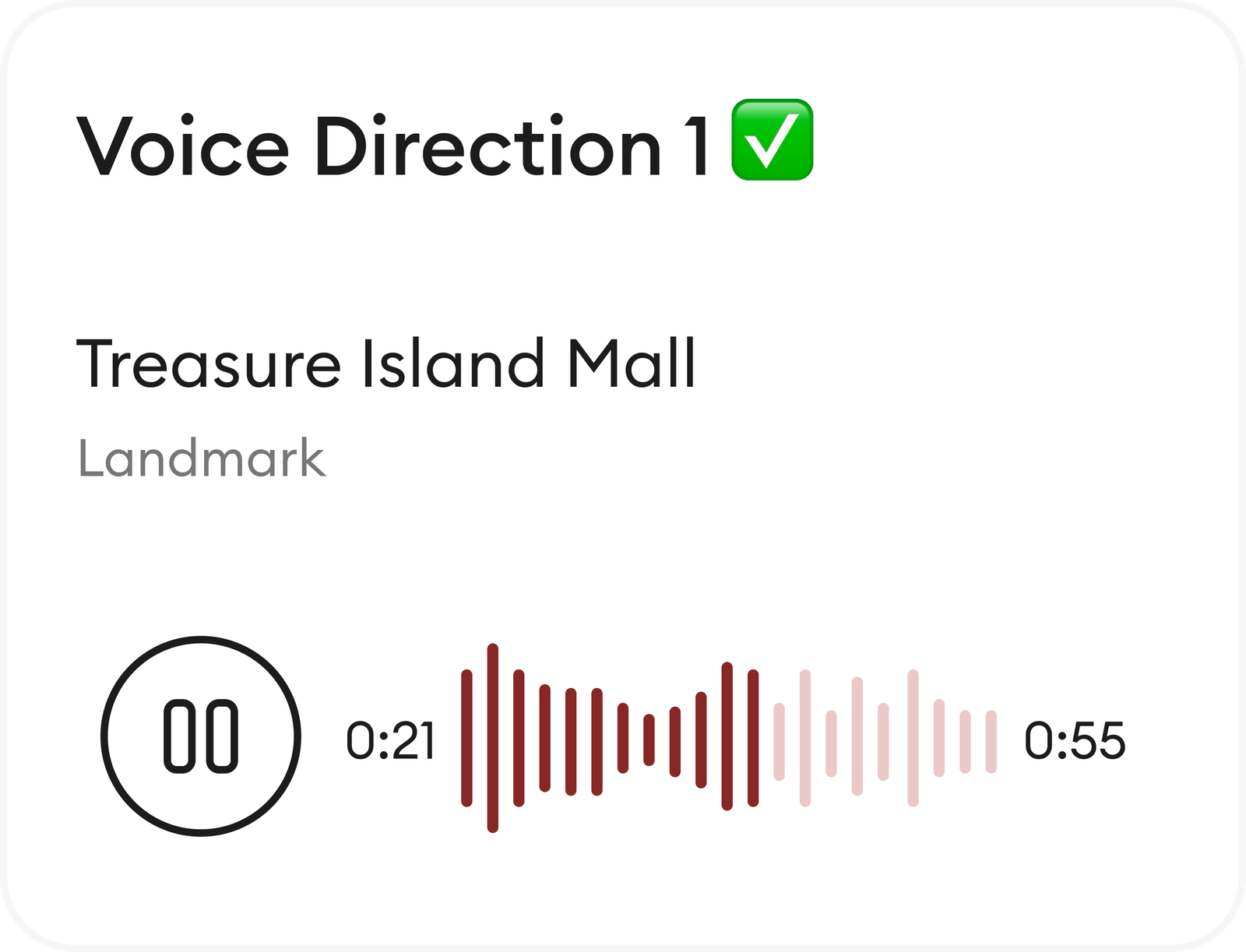
IMAGE UNAVAILABLEVoice direction review artifact.
Recognize the entrance
Voice direction review artifact.
03 / Share with consent
A prominent, active state with a limited duration
Active sharing shows who receives it, the remaining duration, and a visible stop action.
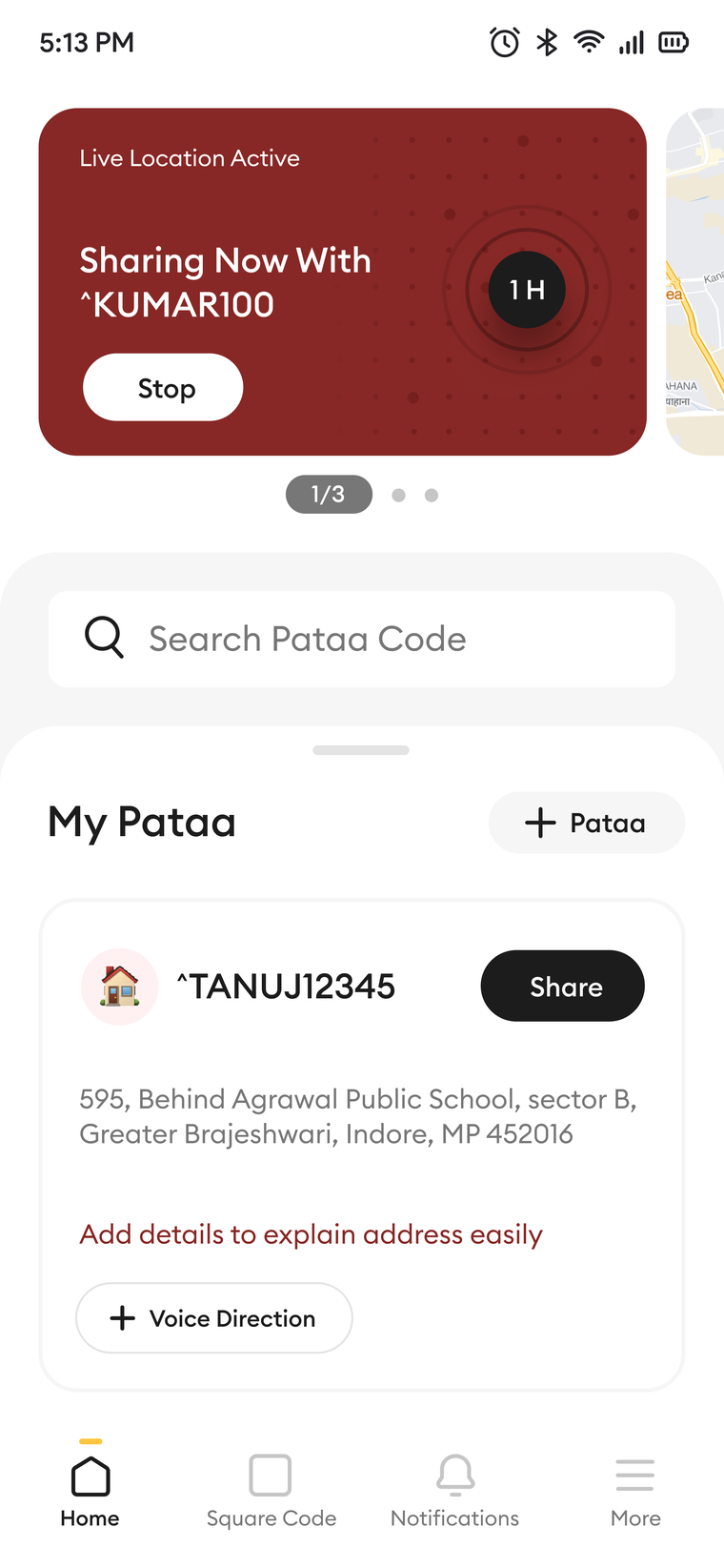
IMAGE UNAVAILABLEProminent active state for live location sharing.
Share with consent
Prominent active state for live location sharing.

IMAGE UNAVAILABLEPromotional graphic reading “Now Share Your Location Instantly” beside a map pin.
Sharing prompt
A promotional prompt for instant location sharing, shown separately from the active sharing controls.
04 / Around the code
Adjacent product surfaces
Home, Square Code, weather, and delivery concepts show how the address object extends beyond the core creation flow.
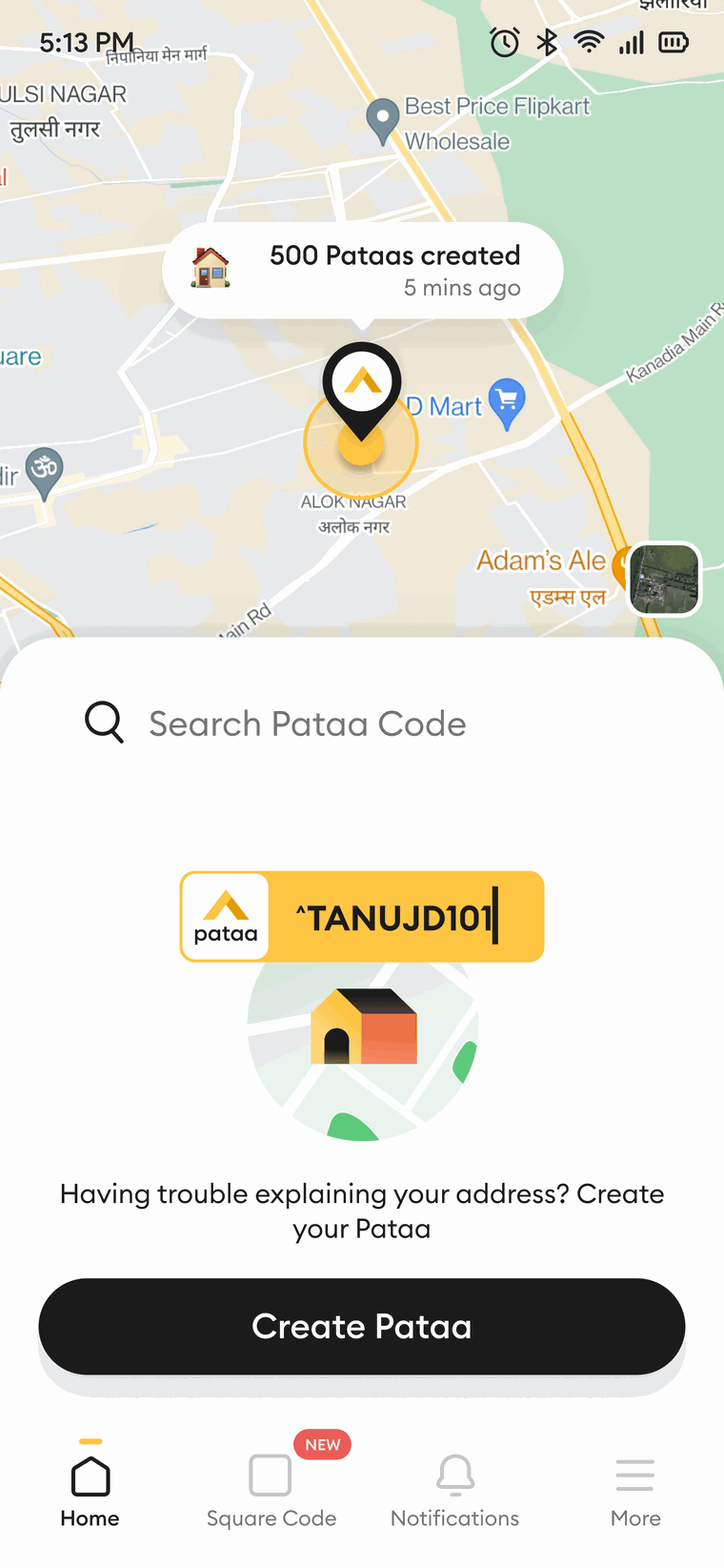
IMAGE UNAVAILABLEPataa mobile home surface.
Around the code
Pataa mobile home surface.
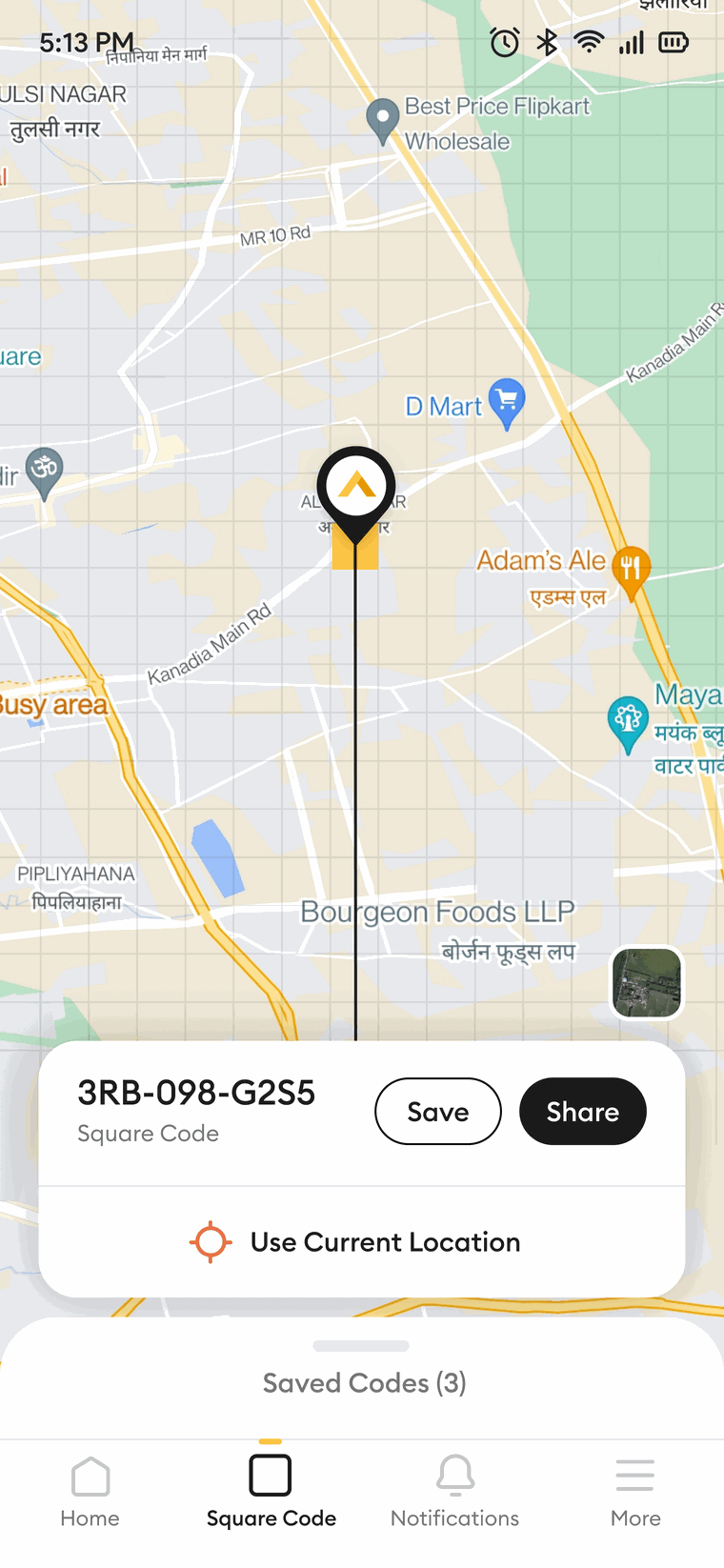
IMAGE UNAVAILABLESquare Code scanning surface.
Around the code
Square Code scanning surface.
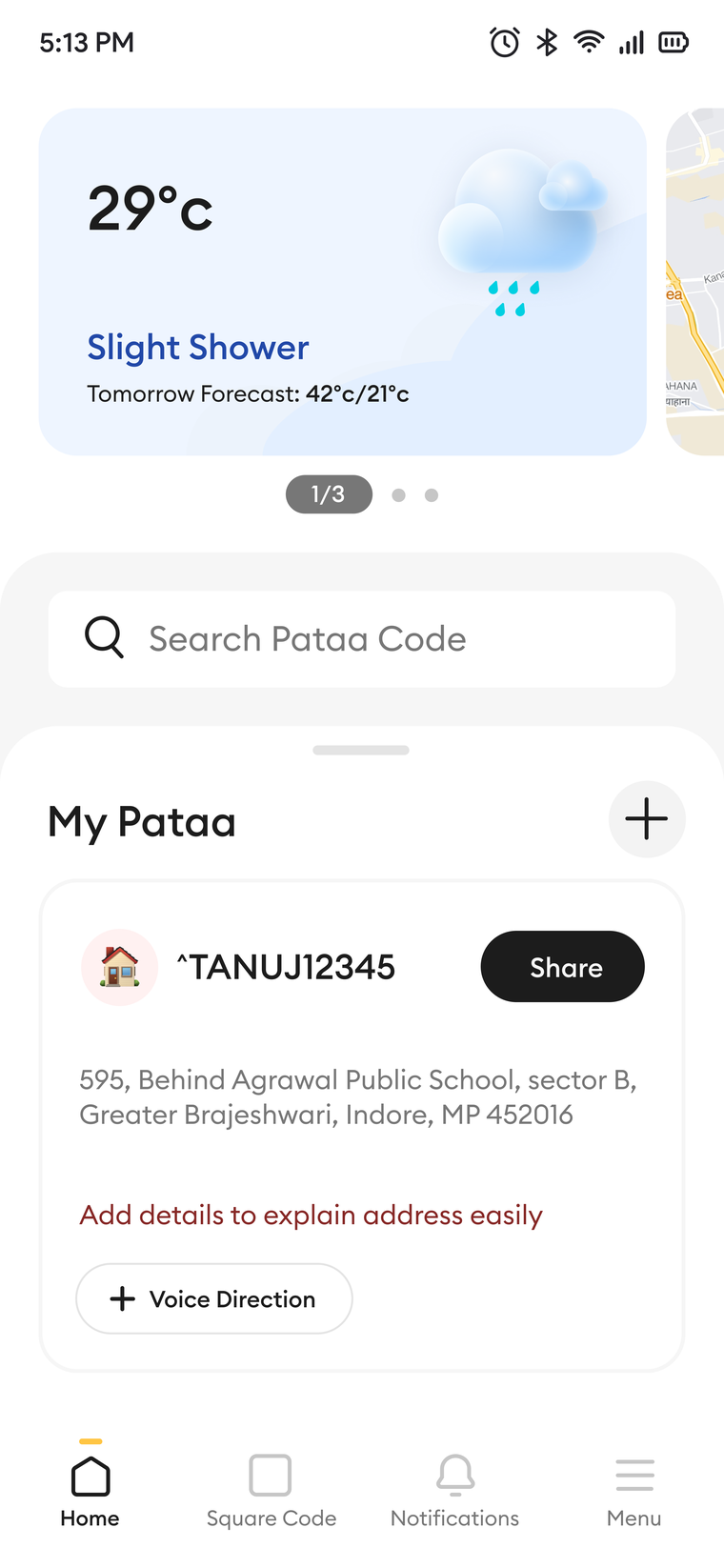
IMAGE UNAVAILABLEWeather attached to a precise address block.
Around the code
Weather attached to a precise address block.
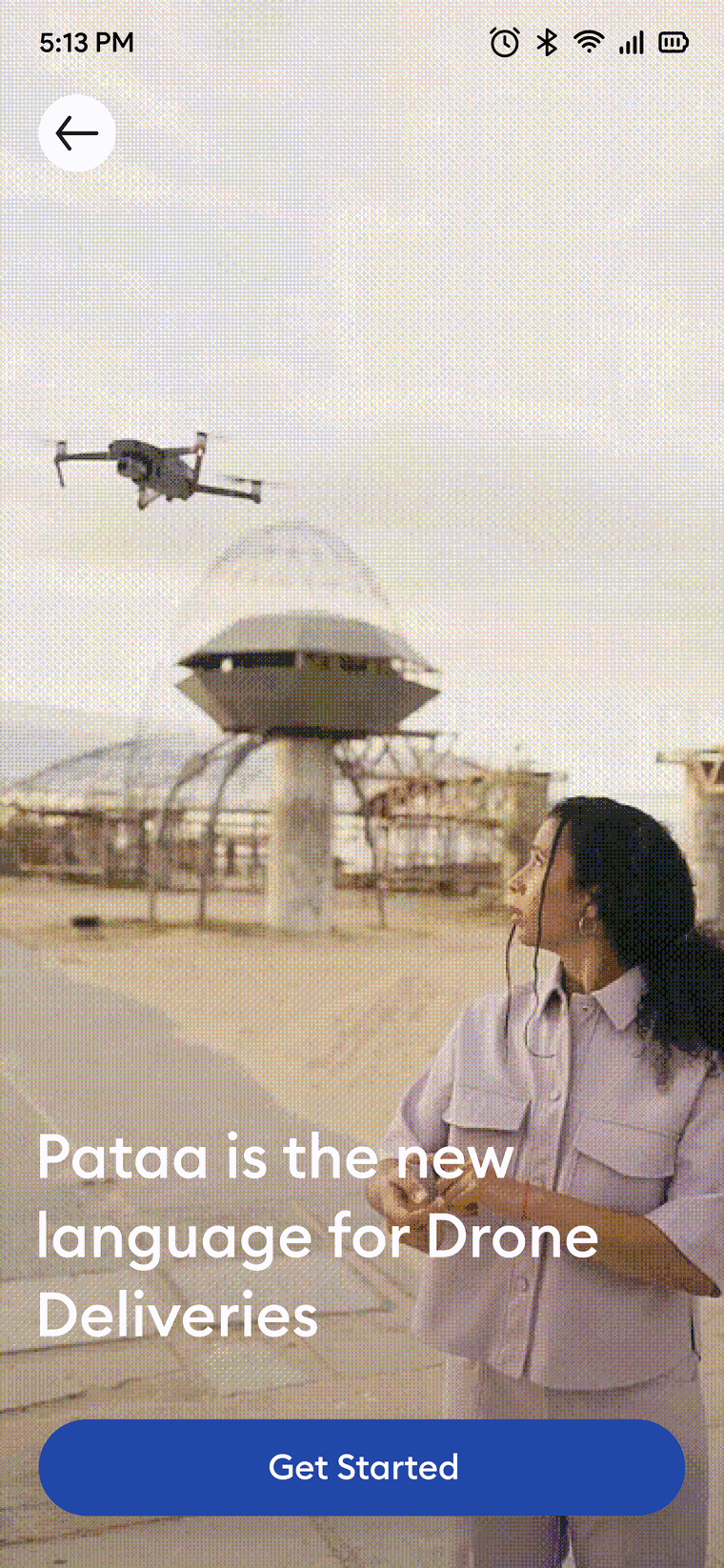
IMAGE UNAVAILABLEPataa drone delivery product teaser.
Around the code
Drone delivery concept.
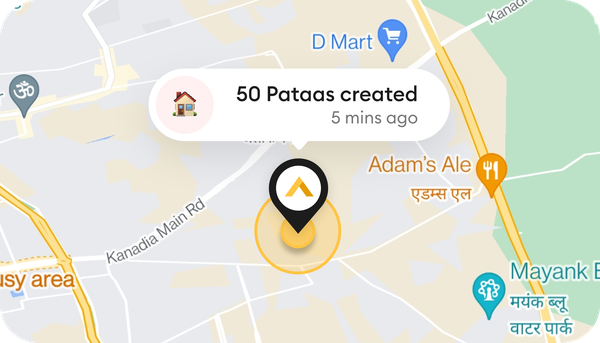
IMAGE UNAVAILABLEMap activity toast showing 50 Pataas created five minutes ago above a location pin.
Map feedback
A map activity toast reports that 50 Pataas were created five minutes ago.
Testing clarified the next iteration
Participants found the route preview cluttered and valued richer guidance. The next iteration focused on simplifying the preview.
Testing in two phases: internal review with stakeholders, product managers, and the design team, then moderated sessions with six users selected to match the personas.
RESULT Testing exposed a cluttered route preview and reinforced the value of voice directions; preview simplification was recorded as the next iteration.
What this work covers
- Neel contributed to research, synthesis, journeys, onboarding, creation, sharing, and rich media direction flows as part of the team.
- Pataa and its ShortCode location system predated the redesign.
- The app's 7.5M+ downloads describe overall product reach, not individual design impact.
What changed in the practice
Lesson
Honesty can be treated as a design material, especially when an interface shares a person's location.
Keep
Refuse the obvious brief and let research distinguish a shorter address from a trustworthy one.
Change
Test onboarding earlier because teaching the ShortCode address concept is itself a core design problem.
Carried forward
Make live state, recipient, duration, and control visible.