Owned the product structure, task hierarchy, interaction model, screens, states, design system, and the rules that prevent missing or failed data from reading as good news.
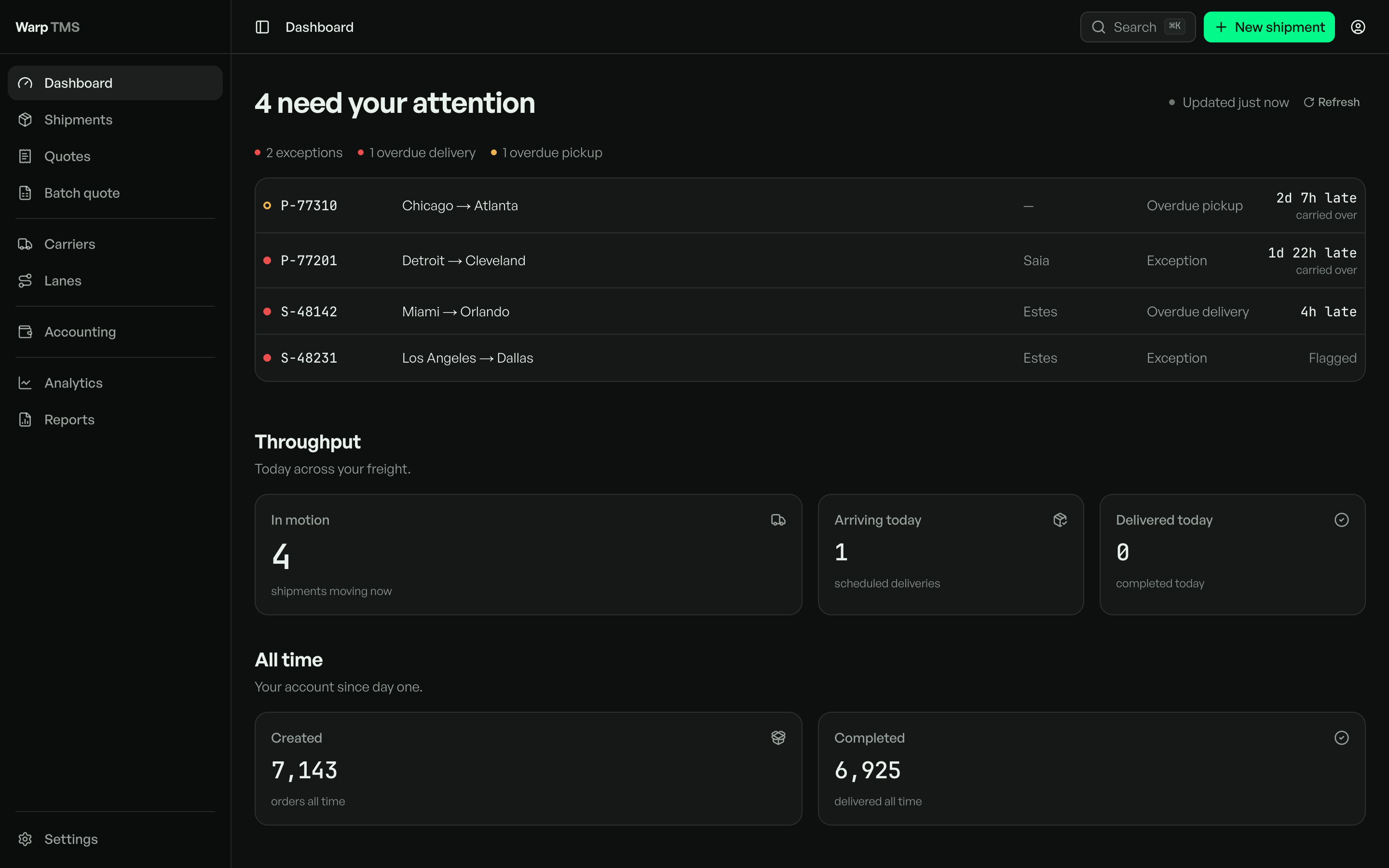
IMAGE UNAVAILABLEPrimary operator console overview.
IMAGE UNAVAILABLETransaction surface from quote through booking.
CASE 04Operator TMS / freight network
Warp TMS: A free TMS built to move the freight underneath it
Warp's bet is to give small shippers the operating software for free and earn when their loads move through its freight network. Neel designed the information architecture, operator console, shipment working set, path from quote to booking, and the states that keep freight information honest. The acquisition funnel and immediate onboarding payoff were developed with Warp cofounder and CRO Troy Lester.
Troy and Neel shaped the path from first contact to onboarding payoff. Warp leadership set the product and commercial frame; the freight network and operating systems remained team owned.
The product is not generally available, and no defensible active user or adoption count is available.
A free tool had to become the operator's daily surface
The business model and the interface meet when an operator trusts the tool enough to move from triage to a real booking.
The primary user opens a TMS when something is already broken. The first screen has to answer “what needs me now?” without a wall of alarms, then make quoting, booking, tracking, and recovery fast enough to keep the work inside Warp.
- An SMB shipping or operations manager triaging exceptions throughout the day.
- Finance and back office users reconciling spend and invoices to the dollar.
- A prospective shipper evaluating Warp from one freight history upload.
- No direct shipper interview, diary study, survey, or funded panel informed the initial design.
- Requirements came from Warp sales knowledge, a competitor teardown, and published secondary sources.
- That limitation made honest states a firm requirement: unknown cannot become zero, and a failed read cannot become “all clear.”
A free tool that is abandoned on day two acquires nothing. A tool that fabricates status or cost loses the operator the first time the lie is caught.
01 / Strategy mechanism
A funnel Troy and Neel created together, from free tool to freight network
Troy and Neel designed the handoff from the places a shipper already works, through an immediate freight history payoff, into the daily TMS and its path from quote to booking.
Real freight changed the priorities
Operational data exposed where hierarchy, state clarity, map legibility, and response time mattered most to the operator's day.
The console leads with the loads that need action now, then tapers toward calmer operational reads.
Hierarchy follows urgency instead of giving every card equal weight.Disconnected, loading, empty, and failed reads each receive a distinct explanation and recovery path.
The interface never turns missing information into a false all clear.A slow quote history view was repaired after freight scale made the wait impossible to ignore.
Measured on the quote history path.Dense routes over short distances led to clearer arcs and volume markers instead of circles and stubs.
Real freight shaped the visual treatment of route density.01 / Working set with real data
Ranked triage over equal card weight
The console starts with one truthful sentence, ranks the loads that need attention, and tapers toward calmer reads. The shipment table keeps most rows neutral so a true exception can still carry meaning.
IMAGE UNAVAILABLEPrimary operator console overview.
Command center
The current task hierarchy begins with what needs the operator now.
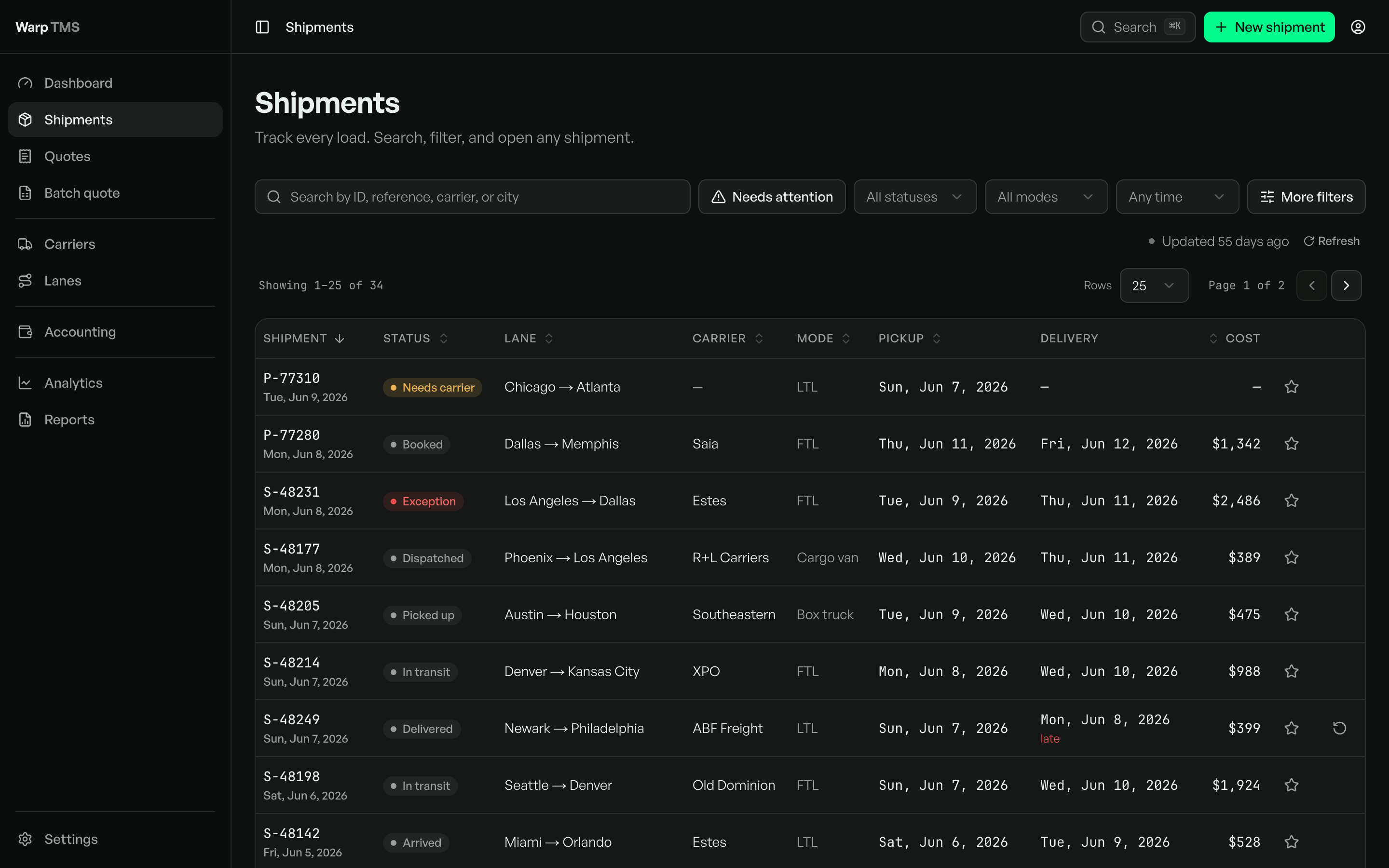
IMAGE UNAVAILABLEOperational shipments working set.
Shipment working set
Search, filters, aligned numbers, and honest missing values in the current working set.
Five rules turned strategy into product behavior
The design keeps assistance accountable, states truthful, patterns consistent, and quoting focused on the operator's next decision.
How should leadership's free tool bet become a product?
Make the TMS valuable enough for daily work, then embed quoting and booking directly in the daily workflow.
Warp leadership set the free software strategy. Neel designed the operator product, then created the acquisition path with Troy.
REJECTED PATH Package the TMS as conventional paid SaaS and separate it from the network moment.
How can natural language help without fabricating freight facts?
Translate the request into filters, then show the matching freight records.
Assistance narrows the working set; it does not invent shipment IDs, costs, statuses, or conclusions.
REJECTED PATH A chat surface that narrates shipment status in generated prose.
Why did the original interface keep drifting?
Define shared components, spacing, and state rules before polishing individual screens.
Competing card patterns and spacing conventions made equivalent information behave differently across the product.
REJECTED PATH Continue polishing one screen at a time without a shared interface system.
What should the interface show before live data is available or when a live read fails?
Give disconnected, empty, loading, and error states their own clear behavior.
A failed read must say it failed instead of showing a hopeful blank or false all clear.
REJECTED PATH Use a spinner or silent empty surface for every error or state with unavailable data.
What should happen when a quote form accumulates “useful” fields?
Remove the mode, source, freight class, and NMFC controls that do not earn their place in the first decision.
The flow returned to quantity, total weight, and dimensions; carrier source moved after rates, while the information needed for booking stayed intact.
REJECTED PATH Keep every “good to have” field and make the operator solve system complexity before seeing a rate.
The operator loop starts with payoff, then keeps assistance accountable
Onboarding, spreadsheet mapping, filtering, quoting, and recovery each balance speed with the operator's need to inspect and trust the result.
01 / Immediate payoff
Return the shipper's own freight history before asking for setup
The onboarding flow Neel and Troy created reads back spend, carriers, and lanes, then makes “Open my TMS” the graduation action into daily freight work.
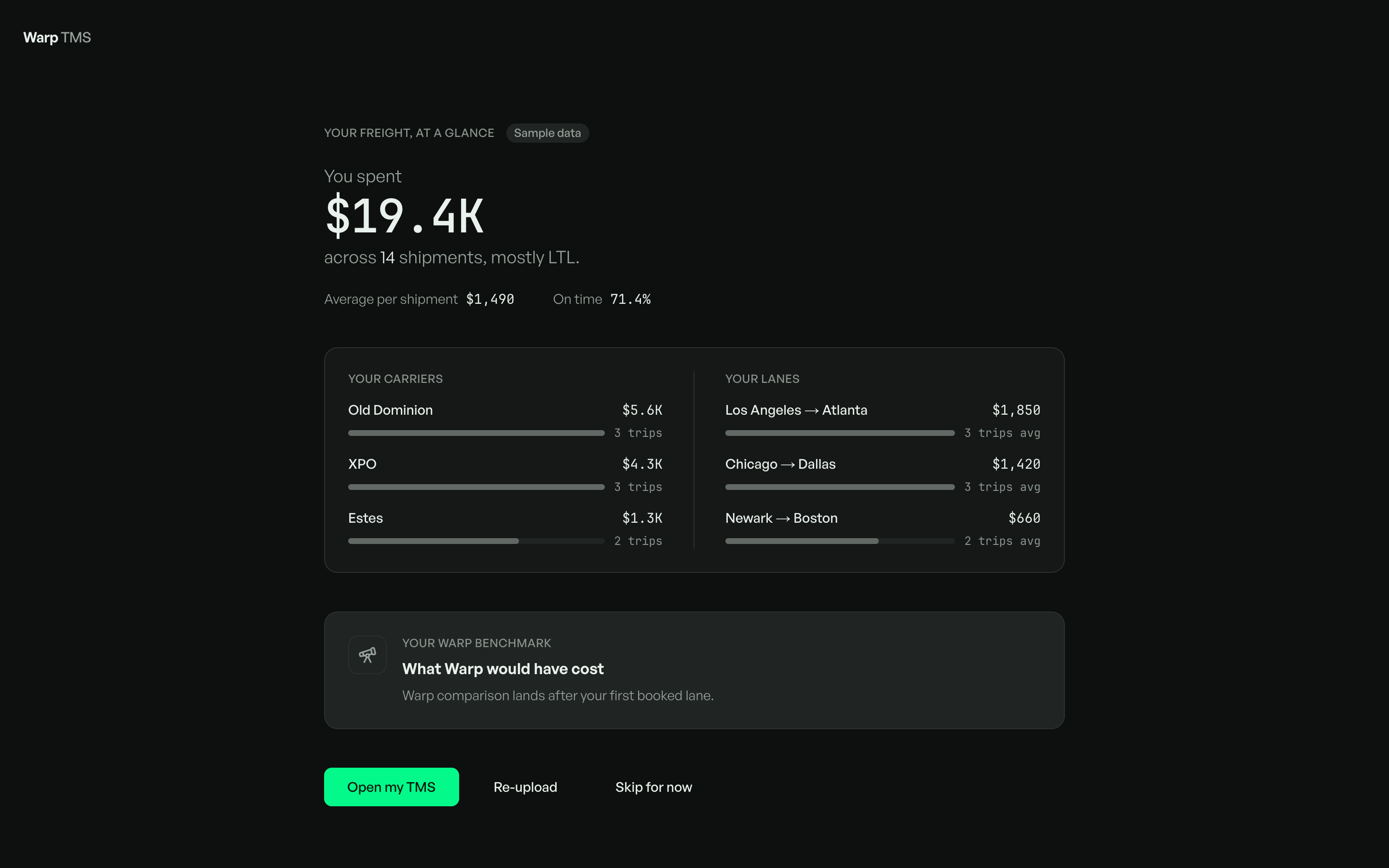
IMAGE UNAVAILABLEImmediate payoff from the shipper's own freight history.
Immediate payoff
The shipper sees value from their own freight history before deeper setup, while the unavailable benchmark stays visibly deferred.
02 / Import assistance
Editable column mapping before import
The system suggests spreadsheet column matches; the operator can inspect and edit every one before rows enter the TMS.
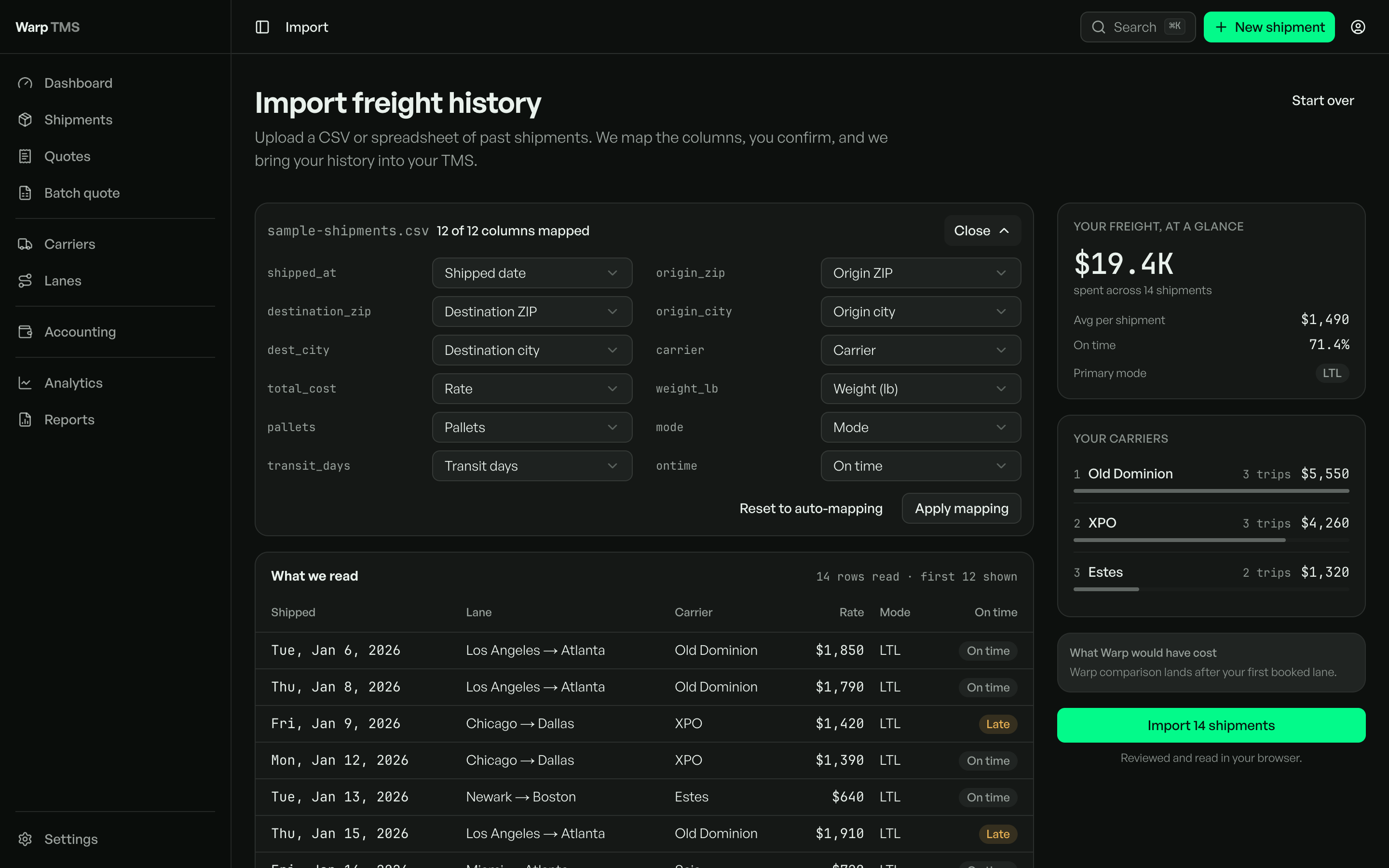
IMAGE UNAVAILABLEColumn mapping assisted by AI with visible, editable mappings before import.
Import assistance
Every proposed column mapping remains visible and editable before the sample rows enter the TMS.
03 / Query assistance
Shipment filters, not generated freight prose
A plain language request becomes an inspectable filter. The product then shows the matching shipment IDs, costs, statuses, and a shareable view.
04 / Transaction path
Lane to rate to booked load
The quote sheet asks only for the information needed to return rates; booking gets its own calm route with the selected rate held in context. This is where daily TMS work can become freight on Warp's network.
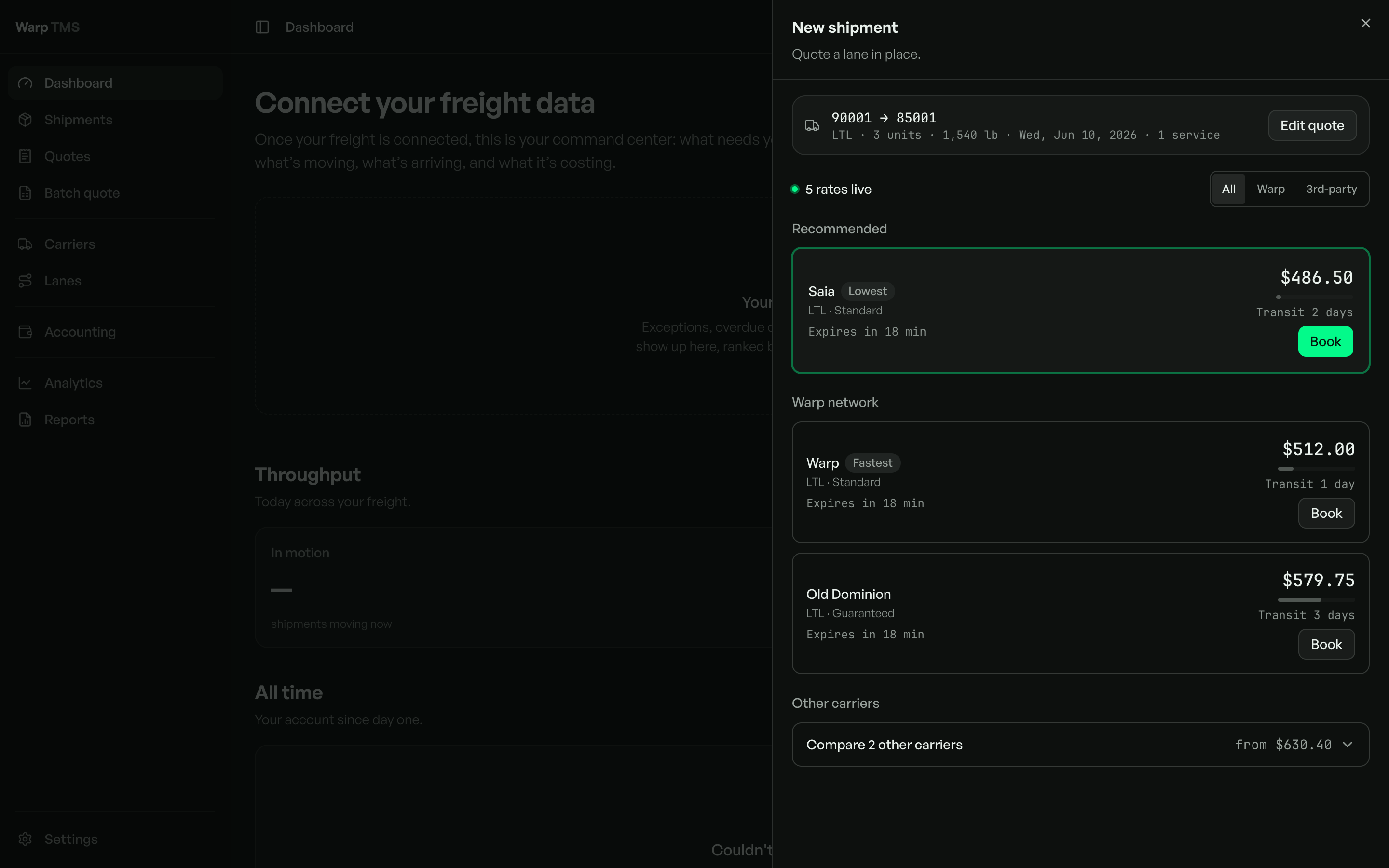
IMAGE UNAVAILABLETransaction surface from quote through booking.
Transaction path
Comparable rates, recommendation context, and booking actions stay inside one workflow.
05 / Truth states
Disconnected, empty, loading, and error states
The system names what it knows before a freight connection is ready and when a live read fails.
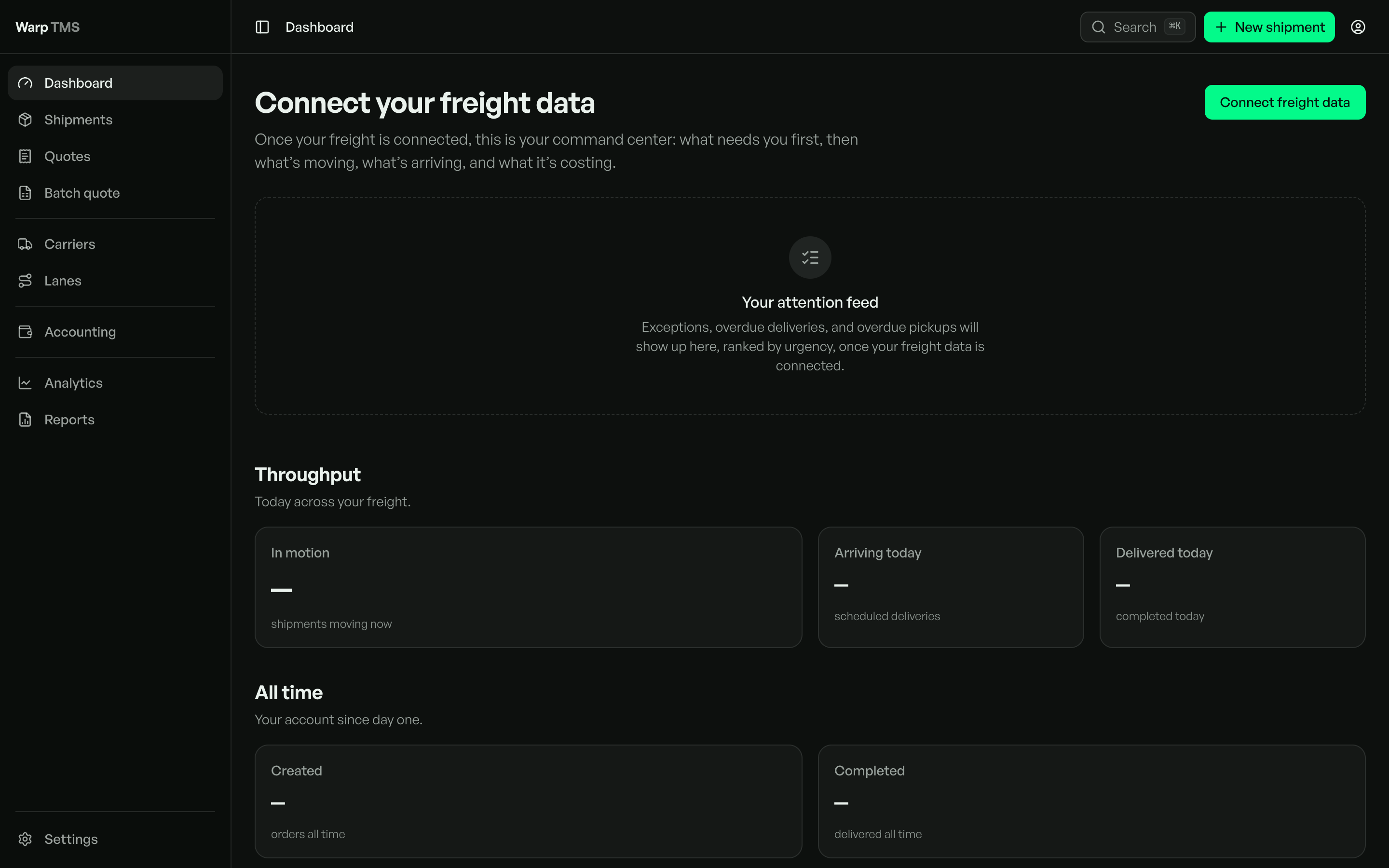
IMAGE UNAVAILABLEDisconnected state before freight data is connected.
Disconnected
The interface explains what connection enables and avoids presenting sample values as live data.
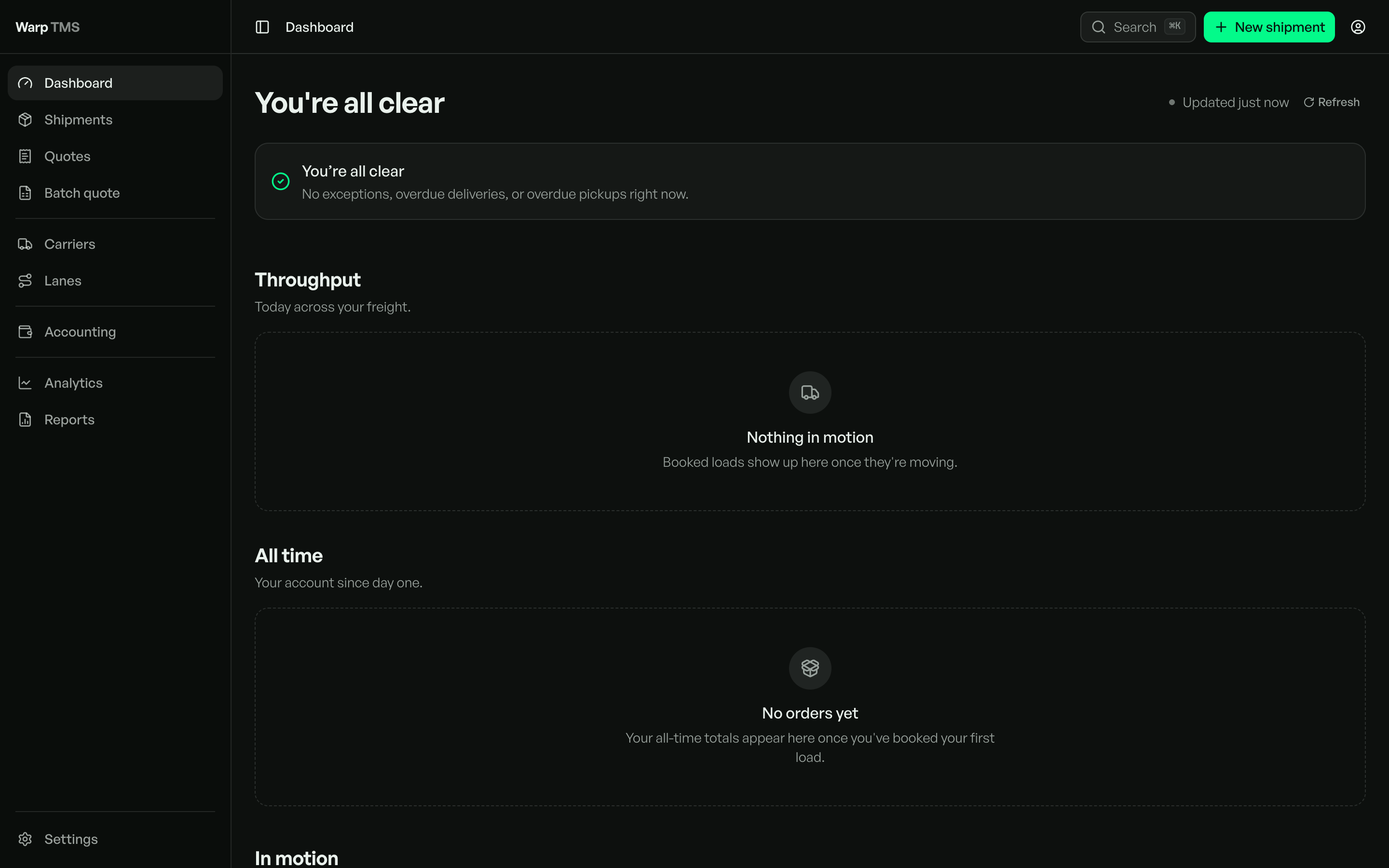
IMAGE UNAVAILABLEDesigned empty state.
Empty
Zero exceptions, zero moving loads, and no historical orders each receive the right explanation.
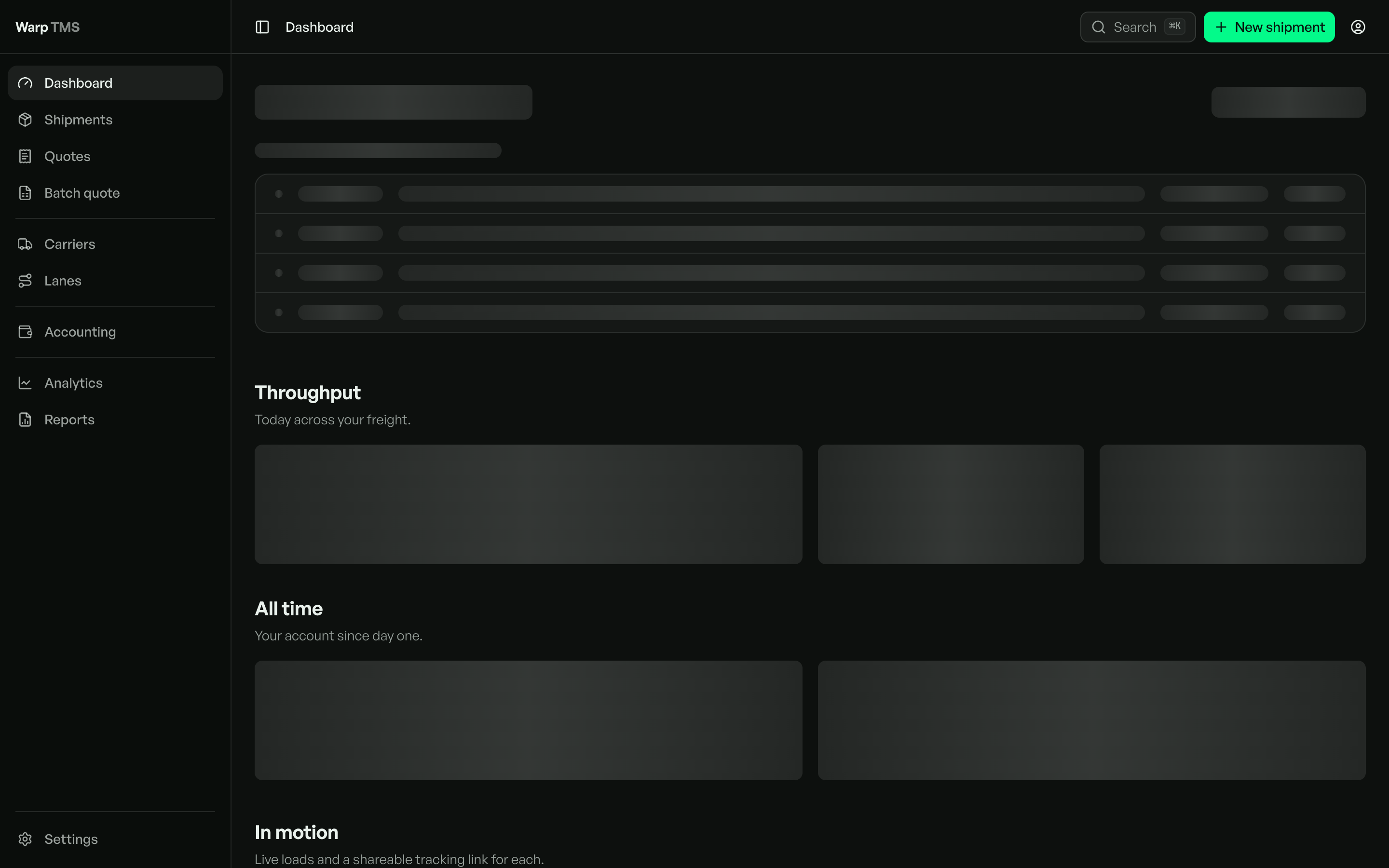
IMAGE UNAVAILABLESkeleton state mirroring the final layout.
Loading
Skeleton geometry mirrors the final feed and metric groups to minimize the transition into real content.
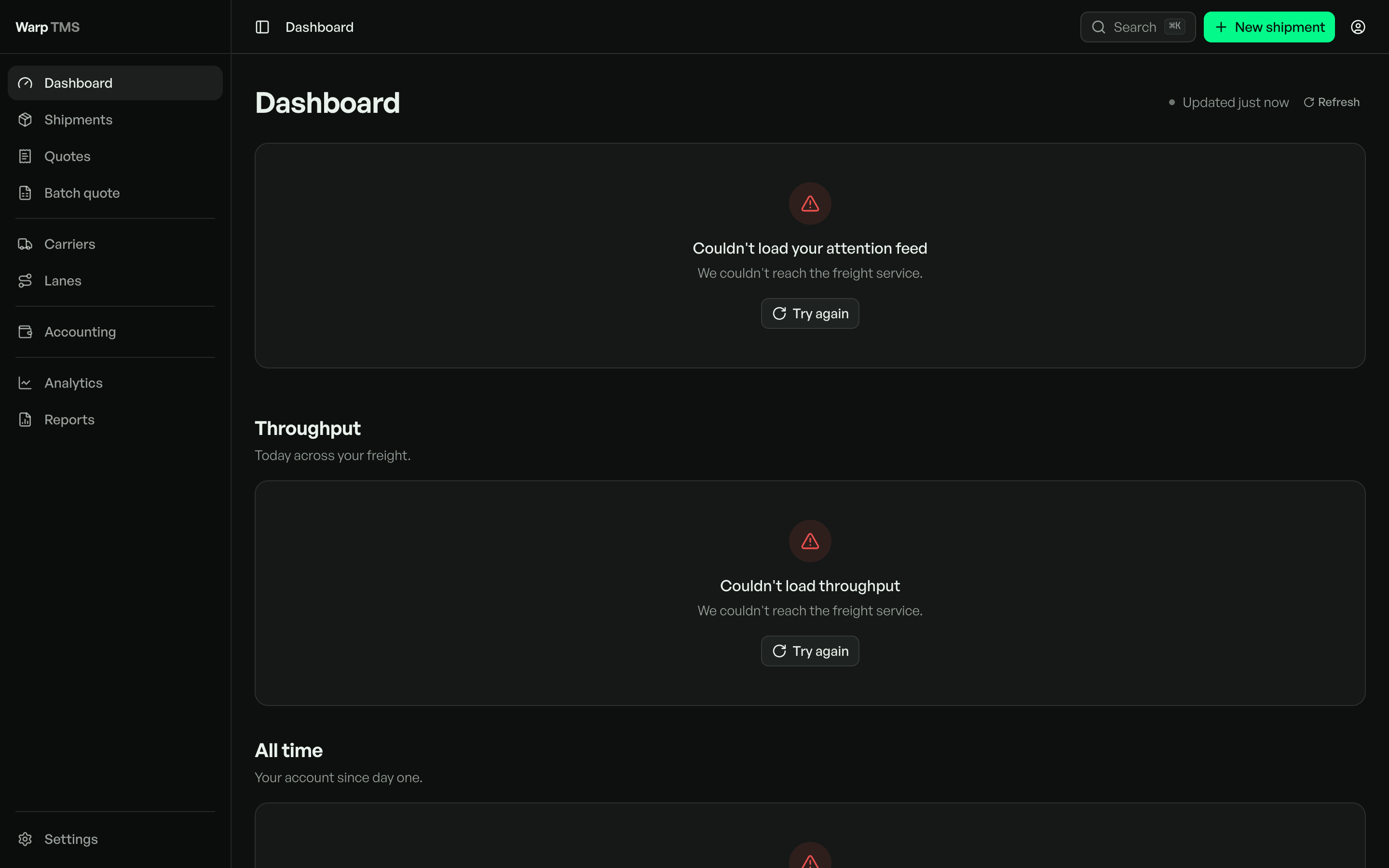
IMAGE UNAVAILABLEDesigned data read error state that says the read failed.
Error
Failed reads identify the affected section and offer local recovery instead of collapsing the page.
Real freight exposed what polished screens could not
Operational scale revealed unclear short route geometry, a workspace separation flaw, and a quote history wait that blocked the task.
01 / Iteration with real freight
The lane map after short routes stopped collapsing into circles and stubs
Live lane density drove arcs curved by distance and filled volume nodes. The same review exposed a workspace separation flaw and an unusable wait in quote history.
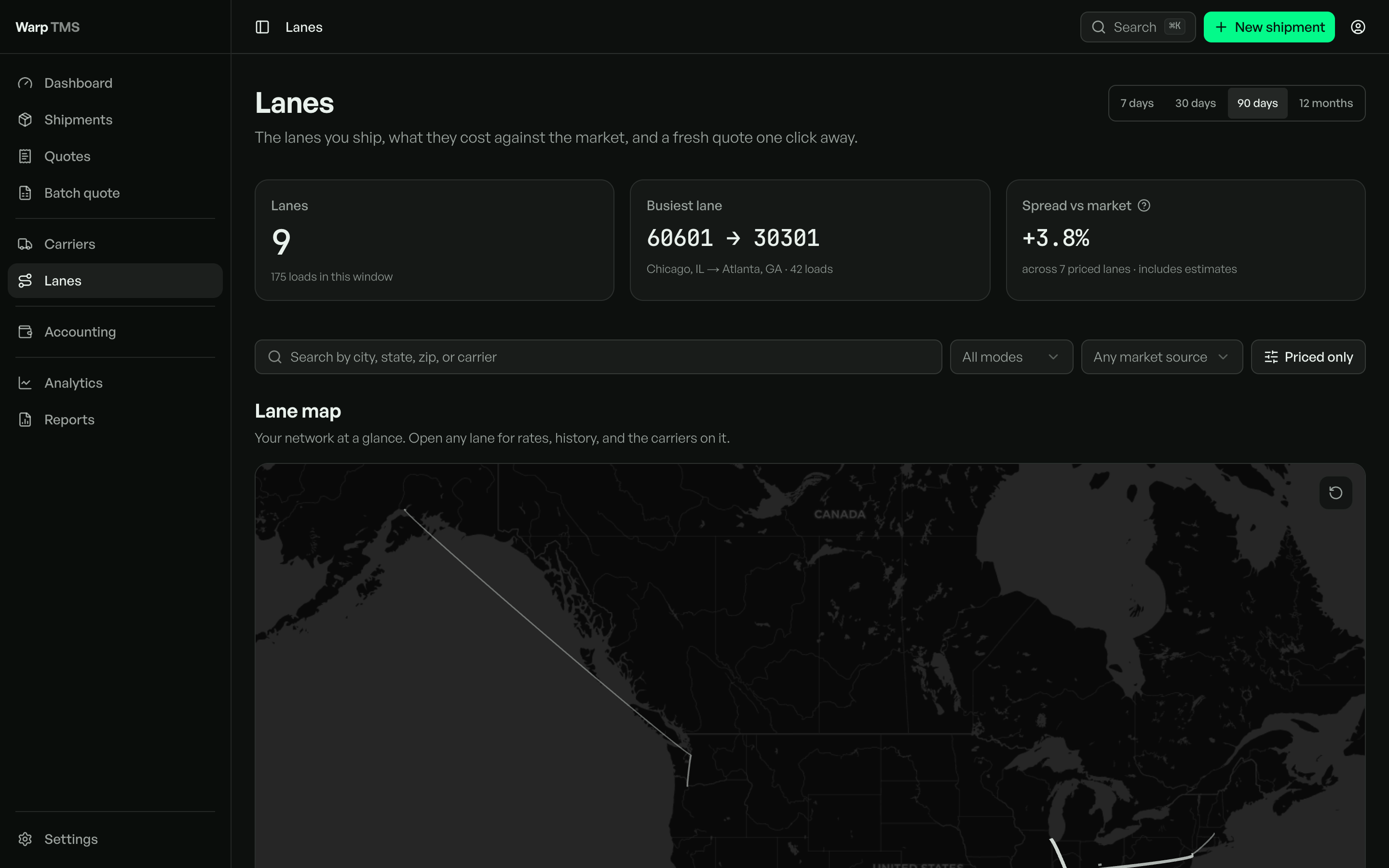
IMAGE UNAVAILABLELane map shown in the repair story using real data.
Lane intelligence
Historical volume, market spread, filters, and route geometry stay within one period covering 90 days.
Operational freight was used to challenge the working set, map, and quote history flow.
RESULT Short route geometry became clearer, freight stayed within the correct workspace, and the measured quote history wait fell from 227 seconds to about 120 milliseconds.
DESIGN LEARNING Freight scale has to shape the interface before density becomes an operator problem.
Keyboard, touch, loading, empty, disconnected, and error states were reviewed as part of the same interface.
RESULT Interactive targets use a 44px floor, focus remains visible, and missing information never appears as a false zero or all clear.
DESIGN LEARNING Recovery behavior belongs in the core task model, not after the happy path.
What this case covers
- The operator console, shipment working set, quote and booking flow, and recovery states.
- An immediate onboarding payoff and acquisition path into daily freight work.
- Iteration with real freight across task hierarchy, map clarity, workspace separation, and response time.
- Shared interface rules across dense tables, maps, forms, and state changes.
What changed in the practice
Lesson
Strategy becomes real through the acquisition path and the daily work beneath the headline bet.
Keep
Turn repeated interface corrections into shared patterns so equivalent tasks stay consistent.
Change
Future research should measure first value, exception recovery, and repeat use with shippers directly.
Carried forward
Never let the interface lie to an operator.